Jun 26, 2026Market Insights
Kids vs. Pets Why Companion Animals Are Becoming the New Center of the Household
Birth rates are falling worldwide, but pet populations are rising faster than ever. In many countries, dogs and cats now outnumber children—sometimes by a factor of four.
Across the world, birth rates are falling while pet ownership continues to rise—creating a demographic shift that is reshaping families, lifestyles, and the global pet industry. In many countries, dogs and cats now outnumber children and young people by a wide margin, in some cases by a factor of four.
This trend is not temporary. It reflects deeper economic, social, and emotional changes that are redefining what “family” means today.
1. Two Global Curves Moving in Opposite Directions
Euromonitor International’s data from 47 countries shows a clear divergence:
Birth Rates (per 1,000 population)
- 2020: 17
- 2025: 16
- 2030 (projected): just above 15
Dog & Cat Population
- 2020: ~900 million
- 2025: surpasses 1 billion
- 2030 (projected): 1.1+ billion
The pandemic accelerated both trends, but the divergence continues even after global recovery.
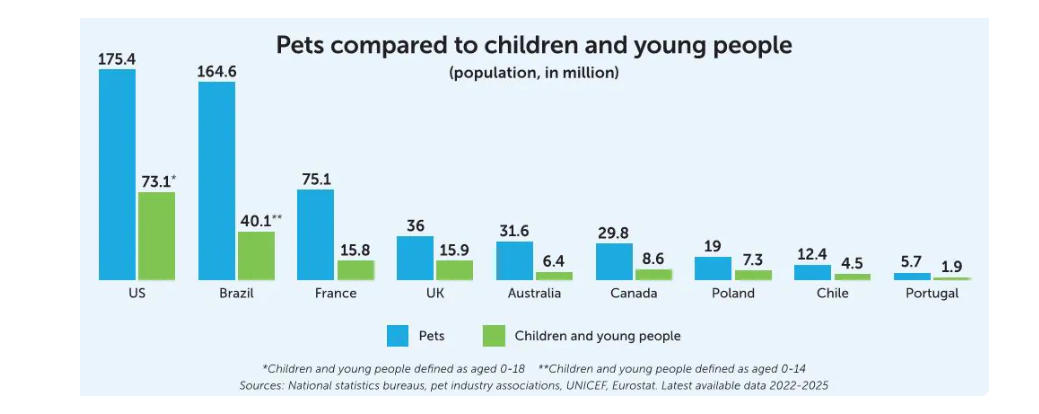
2. Pets Outnumber Children in Many Countries
Australia
- 31.6 million pets across 7.7 million households
- 13.1 million dogs & cats
- 6.4 million children & youth → Pets = 2× the youth population
France
- 26+ million dogs & cats
- 15.8 million youth (0–19) → Pets significantly exceed children
UK
- 26 million dogs & cats
- 15.9 million youth → Pets = 1.6× youth population
Poland
- 8.5M dogs + 7.5M cats = 16M
- 7.3M youth → Pets > youth
Portugal
- 5.7M pets
- 1.9M youth → Pets = 3× youth population
Brazil
- 164.6M pets
- 40.1M youth (0–14) → Pets = 4× youth population
United States
- 175.4M pets
- 73.1M youth (<18) → Pets = 2.4× youth population
Canada
- 29.8M pets
- 8.6M youth → Pets = 3.4× youth population
Across continents, the pattern is consistent: pets are becoming more common than children.
**3. Why Is This Happening?
Economic, Social, and Emotional Drivers**
Economic Pressures
UNFPA’s global survey (14,000 adults, 14 countries) shows the top barriers to having children:
- 39% financial constraints
- 21% unemployment or job insecurity
- 19% housing limitations
Other reasons include:
- Lack of suitable partner (14%)
- Political/social concerns (14%)
- Changing personal decisions (13%)
Lifestyle Shifts
- More single-person households
- Urban isolation
- Flexible work-from-home arrangements
- “DINKWADs” (Double Income, No Kids, With A Dog)
- Desire for companionship without long-term parental responsibilities
Pets fit modern lifestyles better than children for many households.
4. Consumer Cases
Case 1: “We’re not ready for kids, but we wanted companionship.”
Many young couples on Amazon mention adopting a dog or cat instead of having children due to financial pressure or unstable housing.
Case 2: “My dog is my emotional support during remote work.”
Post-pandemic reviews show a surge in pet adoption among remote workers seeking companionship.
Case 3: “We downsized our home—pets fit our lifestyle better.”
Urban buyers often choose pets because children require more space, stability, and long-term planning.
Case 4: “We treat our pets like our kids.”
A common theme in reviews for premium pet products:
Consumers willingly spend on high-quality nutrition, accessories, and wellness because pets are viewed as family members.
Case 5: “We travel a lot—pets are easier to manage.”
Frequent travelers prefer pets over children due to flexibility and lower long-term commitments.
These cases reflect a global shift: pets are filling emotional, social, and lifestyle roles traditionally associated with children.
5. What This Means for the Pet Industry
Euromonitor’s analysis shows that demand is becoming more sophisticated—not just premium, but functional, health-focused, and human-grade.
Industry implications
- Higher spending per pet
- Growth in functional nutrition
- Expansion of outdoor gear, accessories, and enrichment
- Increased demand for safety, comfort, and performance
- More investment in innovation
- Stronger emotional branding opportunities
The global pet care industry is expected to grow at a 3% CAGR from 2025–2030.
6. What This Means for Pet Brands Working with OEM Partners
Challenges
- Consumers expect human-grade quality
- Demand for functional gear is rising
- Competition on Amazon is intensifying
- Brands need differentiation, not just price advantage
What Brands Need
- High-quality materials (reflective, cooling, waterproof, durable)
- Functional outdoor gear (harnesses, bandanas, travel accessories)
- Customizable OEM/ODM solutions
- Faster innovation cycles
- Exclusive designs for retail differentiation
How OEM Partners Add Value
- Provide advanced materials (iridescent reflective, cooling fabrics, breathable mesh)
- Support private-label development
- Ensure consistent quality for global distribution
- Enable exclusive SKUs for retailers
- Offer scalable production for fast-growing categories
As pets replace children in many households, the demand for premium, functional, and emotionally resonant pet products will only accelerate.
Source:GlobalPETS