Jun 26, 2026Market Insights
Russian Pet Market Expands on Domestic Production Despite Deepening Price Polarization
The Russian pet market reached ₽590 billion in 2025, growing 15.8% YoY despite sanctions and supply constraints.
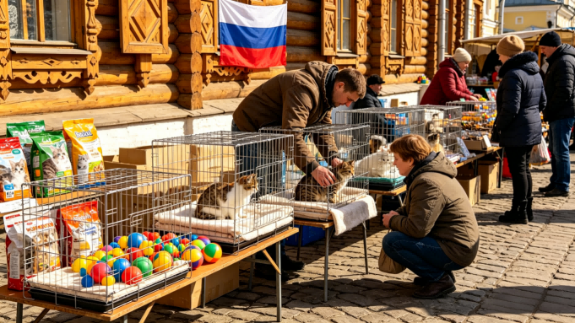
The Russian #petindustry continued its upward trajectory in 2025, growing 15.8% YoY to reach ₽590 billion ($7.6B / €6.5B), according to estimates from Zooinform. Although the market expanded, the growth rate was slightly below 2024’s 17.7% increase.
Zooinform’s Chief Operating Officer, Yulia Dolzhenkova, notes that the market is still advancing, but the nature of growth has shifted. She describes the 2025 landscape as “more mature”—strong in value, yet constrained in real demand, with intensified competition for shelf space and repeat purchases.
1. Growth Drivers
Inflation played a larger role in value growth last year, while new demand remained limited—mirroring broader FMCG trends. Nielsen estimates that in the 12 months to October 2025, inflation accounted for 88% of FMCG revenue growth, with only 12% driven by real demand. Pet products followed a similar pattern.
Category Breakdown
- Pet food represents 83% of total #petproduct spending.
- Cat food led the category with 16% annual growth, contributing 59% of total market revenue.
- Treats, though only 3.2% of the market, were the fastest‑growing segment at +24% YoY.
This reinforces a broader shift: consumers are prioritizing essential nutrition while selectively spending more on emotional or health‑linked categories like treats.
2. A Polarized Economy
The Russian market is increasingly split between two realities.
On one side, demand for premium and super‑premium products remains strong among veterinarians and breeder networks, according to Irina Golovchenko, Managing Director at Valta Pet Products.
On the other side, manufacturers such as LIMKORM GROUP report a clear shift toward economic #petfood, with partners requesting more budget‑friendly private‑label production. General Manager Konstantin Anisimov confirms that economic lines are gaining share.
Dolzhenkova summarizes the situation succinctly: the market is “polarized,” with premium resilience coexisting alongside accelerated trade‑down behavior.
3. Value‑Oriented Demand Intensifies
Budget optimization is shaping consumer behavior.
NielsenIQ data shows that hard discounters grew 20.2% in value and 15.4% in volume, reflecting a strong shift toward affordability.
At the same time, premium products offering functional, health‑driven benefits continue to perform well. In cat food, functional diets accounted for 34.9% of sales value in 2025, up from 33.3% in 2024.
Consumers are trading down in routine purchases but still willing to pay more for:
- Health‑linked nutrition
- Functional solutions
- Emotional categories such as treats
Recognizing this, Valta Pet expanded its private‑label portfolio to include small treats and wet food for both cats and dogs.
4. Third Year Under Sanctions
The Russian #petsector continues to adapt to sanctions, which have forced a push toward local production and ingredient localization. Cross‑border supply constraints remain a challenge.
Zooinform estimates that pet food production increased 9% in 2025 as domestic companies scaled up to replace halted foreign supplies.
For Valta Pet, private labels now account for 60% of its portfolio. Golovchenko explains that the company had to develop its own products to sustain operations and protect its 1,100 employees after foreign brands were banned. Another 20% of its assortment now comes from Russian brands created within the past two years.
Manufacturers like AVZ Group also expanded aggressively, launching 5 new pet product lines and 20 farm animal lines in 2025. However, sanctions limited access to essential substances and machinery, pushing companies to seek partners in China and broader Asia.
Exports have also narrowed, now largely restricted to former Soviet states and markets in Asia, the Middle East, and North Africa.
5. Infrastructure Expansion Accelerates
Supply shortages have triggered investment in both production facilities and supporting ingredient manufacturing—such as flavorings, hydrolysates, and additives—to reduce reliance on imported inputs.
Zooinform expects 100,000–150,000 tons of additional annual capacity by 2026 if planned projects launch on schedule.
LIMKORM is among the companies expanding aggressively, with a new wet food plant set for 2026 and plans for another dry food factory within two years. Anisimov forecasts that Russia’s dry pet food market will grow from 800,000 tons to over 1,100,000 tons within a decade—a 40% increase.
6. Market Overview
Russia currently produces 800,000 tons each of dry and wet pet food annually, with 35% classified as premium. Half of all pet food volume is sold through FMCG channels, where standard and economic products dominate.
2025 Retail Channel Breakdown (Zooinform)
- Grocery & non‑specialized retail: 56.2%
- Specialized pet channels: 19.3% (down from 20% in 2024)
- Online: 23.3% (up from 21.8% in 2024)
- Veterinary clinics & breeders: remainder
Zooinform expects the Russian #petmarket to grow 10–13% in 2026, with value‑added categories—treats, functional nutrition, health‑oriented products, and well‑being solutions—continuing to gain share.
For brands, this creates pressure to balance cost‑efficient production with the rising demand for functional, health‑focused products—especially in categories like harnesses, leashes, and recovery gear where durability and performance matter.
What This Means for the Pet Industry
- Market growth is increasingly driven by inflation and local production, not new demand.
- Price polarization is deepening: economic products are expanding while premium survives through functional and health‑linked value.
- Sanctions are accelerating domestic manufacturing, ingredient localization, and infrastructure investment.
- Retail channels are shifting, with discounters and online gaining share.
- Value‑added categories—treats, functional diets, well‑being products—will continue to outperform.
What This Means for Pet Brands Working with OEM Partners
1. The Problems Brands Are Facing
- Rising production costs and ingredient shortages
- Pressure to offer both economic and functional premium lines
- Need for rapid product development as local competition intensifies
- Supply chain constraints due to sanctions and limited import access
2. What Pet Brands Now Need
- Cost‑efficient manufacturing to compete in value‑driven segments
- Flexible production capacity to support both economic and functional SKUs
- Localized supply chains to reduce dependency on restricted imports
- Reliable partners who can scale quickly as domestic demand shifts
3. How OEM Partners Create Value
Strong OEM partners can support brands by offering:
- Cost control through optimized materials and efficient production
- Flexible manufacturing for both high‑volume economic lines and specialized functional products
- Rapid prototyping to respond to fast‑changing consumer needs
- Stable supply chains that reduce exposure to sanctions and import disruptions
This is especially critical for functional outdoor #petgear—harnesses, leashes, collars, recovery suits—where performance, durability, and safety directly influence customer trust.